Tuesday, 10 July 2012

Guitar


The guitar is a plucked string instrument, usually played with fingers or a pick. The guitar consists of a body with a rigid neck, to which the strings, generally six in number, are attached. Guitars are traditionally constructed of various woods and strung with animal gut or, more recently, with either nylon or steel strings. Some modern guitars are made of polycarbonate materials. Guitars are made and repaired by luthiers. There are two primary families of guitars: acoustic and electric.
Acoustic guitars (and similar instruments) with hollow bodies have been in use for over a thousand years. There are three main types of modern acoustic guitar: the classical guitar (nylon-string guitar), the steel-string acoustic guitar, and the archtop guitar. The tone of an acoustic guitar is produced by the vibration of the strings, which is amplified by the body of the guitar, which acts as a resonating chamber. The classical guitar is often played as a solo instrument using a comprehensive fingerpicking technique.
Electric guitars, introduced in the 1930s, rely on an amplifier that can electronically manipulate tone. Early amplified guitars employed a hollow body, but a solid body was found more suitable. Electric guitars have had a continuing profound influence on popular culture. Guitars are recognized as a primary instrument in genres such as blues, bluegrass, country, flamenco, jazz, jota, mariaBefore the development of the electric guitar and the use of synthetic materials, a guitar was defined as being an instrument having "a long, fretted neck, flat wooden soundboard, ribs, and a flat back, most often with incurved sides".[1] The term is used to refer to a number of related instruments that were developed and used across Europe beginning in the 12th century and, later, in the Americas.[2] These instruments are descended from ones that existed in ancient central Asia and India. For this reason guitars are distantly related to modern instruments from these regions, including the tanbur, the setar, and the sitar. The oldest known iconographic representation of an instrument displaying the essential features of a guitar is a 3,300 year old stone carving of aHittite bard.[3]
The modern word guitar, and its antecedents, have been applied to a wide variety of cordophones since ancient times and as such is the cause of confusion. The English word guitar, the German gitarre, and the French guitare were adopted from the Spanish guitarra, which comes from the Andalusian Arabic قيثارةر qitara,[4] itself derived from the Latin cithara, which in turn came from the Ancient Greek κιθάρα kithara,[5] and is thought to ultimately trace back to the Old Persian language Tar, which means string in Persian.
Although the word guitar is descended from the Latin word cithara, the modern guitar itself is not generally believed to have descended from the Romaninstrument. Many influences are cited as antecedents to the modern guitar. One commonly cited influence is of the arrival of the four-string oud, which was introduced by the invading Moors in the 8th century.[6] Another suggested influence is the six-string Scandinavian lut (lute), which gained in popularity in areas of Viking incursions across medieval Europe.[citation needed] Often depicted in carvings c. 800 AD,[citation needed] the Norse hero Gunther (also known as Gunnar), played a lute with his toes as he lay dying in a snake-pit, in the legend of Siegfried. It is likely that a combination of influences led to the creation of the guitar; plucked instruments from across the Mediterranean and Europe were well known in Iberia since antiquity.[citation needed]
Two medieval instruments that were called "guitars" were in use by 1200: the guitarra moresca (Moorish guitar) and the guitarra latina (Latin guitar). The guitarra moresca had a rounded back, wide fingerboard, and several sound holes. The guitarra Latina had a single sound hole and a narrower neck.[7] By the 14th century the qualifiers "moresca" and "latina" had been dropped and these two cordophones were usually simply referred to as guitars.[8]
The Spanish vihuela or (in Italian) "viola da mano", a guitar-like instrument of the 15th and 16th centuries, is widely considered to have been a seminal influence in the development of the guitar. It had six courses (usually), lute-like tuning in fourths and a guitar-like body, although early representations reveal an instrument with a sharply cut waist. It was also larger than the contemporary four course guitars. By the late 15th century some vihuelas were played with a bow, leading to the development of the viol. By the sixteenth century the vihuela's construction had more in common with the modern guitar, with its curved one-piece ribs, than with the viols, and more like a larger version of the contemporary four-course guitars. The vihuela enjoyed only a short period of popularity in Spain and Italy during an era dominated elsewhere in Europe by the lute; the last surviving published music for the instrument appeared in 1576. Meanwhile the five-course baroque guitar, which was documented in Spain from the middle of the 16th century, enjoyed popularity, especially in Spain, Italy and France from the late 16th century to the mid 18th century.[9][10] Confusingly, in Portugal, the word vihuela referred to the guitar, whereas guitarra meant the "Portuguese guitar", a variety of cittern.chi, metal, reggae, rock, soul, and many forms of pop.

Friday, 6 July 2012

GHATAM


The ghaṭam (Sanskrit: घट ghaṭam "pot", Tamil: கடம் kaṭam, Kannada: ಘಟ ghaṭa, Telugu: ఘటం ghaṭaṁ) is a percussion instrument used in theCarnatic music of South India. Its variant is also played in Punjab and is known as Gharha as is a part of Punjabi folk traditions. Its analogue in Rajasthan is known as the madga and pani mataqa "water jug".
The ghaṭam is an earthenware pot; the artist uses the fingers, thumbs, palms, and heels of the hands to strike its outer surface. An airy low-pitch bass sound, called gumki, is created by hitting the mouth of the pot with an open hand. The artist sometimes presses the mouth of the pot against their bare belly, which deepens the tone of the bass stroke, and is another way to produce the gumki sound. Different tones can be produced by hitting different areas of the pot with different parts of the hands. The ghaṭam usually accompanies a mridangam.
Although the ghaṭam is the same shape as an ordinary Indian domestic clay pot, it is made specifically to be played as an instrument. The tone of the pot must be good and the walls should be of even thickness all around to produce an even tone. In fact, there are two types of ghaṭams: Madras and Manamadurai. The Madras ghaṭam is a light pot which requires less force to play, thus is suited for extended fast patterns. The Manamadurai ghaṭam is a heavy, thick pot with tiny shards of brass mixed into the clay. This type of ghaṭam is harder to play but produces a sharp metallic ringing sound which is fa

Etymology

The word ghaṭam in Sanskrit means pot. Variations of this term are used in modern Indian languages.

[edit]Similar instruments

The madga is a north Indian version of the south Indian ghaṭam and is made from a very special clay. The maker sometimes adds some kind of metal or graphit dust to the clay which is responsible for the blue/gray looking and for the special sound.
The madga can be played similarly to the ghaṭam. The extreme bass volume can be produced if one hits with the flat hand the opening at the top of the instrument. The madga can be played also with mallets (sticks) and there is a lot of differentiated sounds which can be produced with this instrument. It is thinner than a ghaṭam but one should not be afraid, it is very stable and not so fragile as one should think.
This clay pot in Gujarat is known as matka, features an almost perfectly round shape (tuned to C#), and is made in many villages in and around Jaipur (Rajasthan) and Gujarat. The matka is used to store water and sometimes yogurt (curd), and can also be used as a cooking vessel. When used as a musical instrument in folk music, it is known as ghaṛa and is played in a similar manner as the South Indian ghaṭam but the technique and rhythmic style is not as refined as that of Carnatic ghaṭam. Another difference is that the ghara is often traditionally played with metal rings on the thumbs, index, middle, and ring fingers of both hands (but players vary on how many rings and fingers are used). There are a few versions of this instrument. Some are made from a black clay that typically comes from a single area in Rajasthan while many others in Rajasthan and Gujarat are made from a reddish clay. A third version of the ghaṛa is made from reddish clay but features a much flatter, squat shape. Both of the red clay types can also be found highly decorated with colorfully painted designs (pictured below) while the black ones are usually plain and unfinished. The black ghaṛas are extremely light but very dense and have a huge sound. The shell tones ring in a bell-like fashion with much more of a sustain than the various South Indian ghaṭams (although the Mysore ghaṭam comes close). The bass tones of this instrument are also very prominent. Since these instruments are fired at a much higher temperature for a longer time than South Indian ghaṭams, there is more consistency between instruments in terms of Western pitch. In other words, there is much less variation in the tuning when compared with ghaṭams from South India, which can range from a low B up to a high A chromatically. Ghaṛas or matkas are usually found with a range from approximately C or C# to D (or slightly higher) although there does not seem to be any indication that these instruments are constructed with tuning considerations. Other spellings for matka include mutkay and madga.vored by some players.

Thursday, 5 July 2012

Mohan veena


The Mohan veena is a stringed musical instrument used in Indian classical music. It derives its name from its inventor Pandit Vishwa Mohan Bhatt
The instrument is actually a modified Archtop guitar and consists of 20 strings viz. three melody strings, five drone strings strung to the peghead, and twelve sympathetic strings strung to the tuners mounted on the side of the neck.[1] A gourd (or the tumba) is screwed into the back of the neck for improved sound quality and vibration. It is held in the lap like a slide guitar. The Mohan veena is under tremendous tension; the total strings pull to be in excess of 500 pounds.[2]
Some of the popular performers include its inventor Pandit Vishwa Mohan Bhatt, fusion artist Harry Manx, former Counting Crows bassistMatt Malley, and Pandit Satish Khanwalkar.

Tuesday, 3 July 2012

VIOLIN-----Construction and mechanics


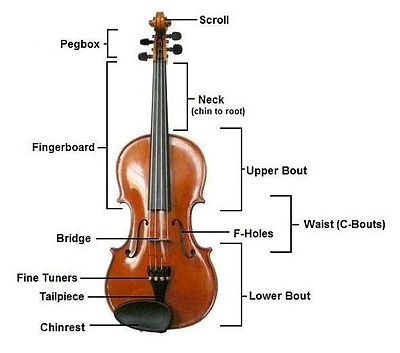
A violin typically consists of a spruce top (the soundboard, also known as the top plate, table, or belly), maple ribs and back, two endblocks, a neck, a bridge, a soundpost, four strings, and various fittings, optionally including a chinrest, which may attach directly over, or to the left of, the tailpiece. A distinctive feature of a violin body is its hourglass-like shape and the arching of its top and back. The hourglass shape comprises two upper bouts, two lower bouts, and two concave C-bouts at the waist, providing clearance for the bow.
The voice of a violin depends on its shape, the wood it is made from, the graduation (the thickness profile) of both the top and back, and the varnish that coats its outside surface. The varnish and especially the wood continue to improve with age, making the fixed supply of old violins much sought-after.
The very great majority of glued joints in the instrument use animal hide glue for a number of reasons: it is capable of making a thinner joint than most other glues, it is reversible (brittle enough to crack with carefully applied force, and removable with warm water) when disassembly is needed, and since fresh hide glue sticks to old hide glue, more original wood can be preserved when repairing a joint. (More modern glues must be cleaned off entirely for the new joint to be sound, which generally involves scraping off some wood along with the old glue.) Weaker, diluted glue is usually used to fasten the top to the ribs, and the nut to the fingerboard, since common repairs involve removing these parts.
The purfling running around the edge of the spruce top provides some protection against cracks originating at the edge. It also allows the top to flex more independently of the rib structure. Painted-on faux purfling on the top is usually a sign of an inferior instrument. The back and ribs are typically made of maple, most often with a matching striped figure, referred to as flame, fiddleback, or tiger stripe.
The neck is usually maple with a flamed figure compatible with that of the ribs and back. It carries the fingerboard, typically made of ebony, but often some other wood stained or painted black. Ebony is the preferred material because of its hardness, beauty, and superior resistance to wear. Fingerboards are dressed to a particular transverse curve, and have a small lengthwise "scoop," or concavity, slightly more pronounced on the lower strings, especially when meant for gut or synthetic strings.
Some old violins (and some made to appear old) have a grafted scroll, evidenced by a glue joint between the pegbox and neck. Many authentic old instruments have had their necks reset to a slightly increased angle, and lengthened by about a centimeter. The neck graft allows the original scroll to be kept with a Baroque violin when bringing its neck into conformance with modern standards.
Closeup of a violintailpiece, with a fleur-de-lis
Front and back views of violin bridge
Sound post seen through f-hole
The bridge is a precisely cut piece of maple that forms the lower anchor point of the vibrating length of the strings and transmits the vibration of the strings to the body of the instrument. Its top curve holds the strings at the proper height from the fingerboard in an arc, allowing each to be sounded separately by the bow. The sound post, or soul post, fits precisely inside the instrument between the back and top, below the treble foot of the bridge, which it helps support. It also transmits vibrations between the top and the back of the instrument.
The tailpiece anchors the strings to the lower bout of the violin by means of the tailgut, which loops around an ebony button called the tailpin (sometimes confusingly called the endpin, like the cello's spike), which fits into a tapered hole in the bottom block. Very often the E string will have a fine tuning lever worked by a small screw turned by the fingers. Fine tuners may also be applied to the other strings, especially on a student instrument, and are sometimes built into the tailpiece.
At the scroll end, the strings wind around the tuning pegs in the pegbox. Strings usually have a colored silk wrapping at both ends, for identification and to provide friction against the pegs. The tapered pegs allow friction to be increased or decreased by the player applying appropriate pressure along the axis of the peg while turning it.
Violin and bow.

[edit]Strings

Strings were first made of sheep gut (commonly known as catgut), or simply gut, which was stretched, dried, and twisted. In the early years of the 20th century, strings were made of either gut, silk, aluminum, or steel. Modern strings may be gut, solid steel, stranded steel, or various synthetic materials, wound with various metals, and sometimes plated with silver. Most E strings are unwound, either plain or gold-plated steel. Currently, violin strings are generally not made of gut, with the exception of violin strings used to play music from the Renaissance, Baroque, or early Classical periods.
Strings have a limited lifetime. Apart from obvious things, such as the winding of a string coming undone from wear, players generally change a string when it no longer plays true, losing the desired tone. String longevity depends on string quality and playing intensity.

[edit]Pitch range

The compass of the violin is from G3 (G below middle C) to C8 (the highest note of the modern piano.) The top notes, however, are often produced by natural or artificialharmonics. Thus the E two octaves above the open E-string may be considered a practical limit for orchestral violin parts.[14]

[edit]Acoustics

3D spectrum diagram of the overtones of a violin G string (foreground). Note that the pitch we hear is the peak around 200 Hz.
The arched shape, the thickness of the wood, and its physical qualities govern the sound of a violin. Patterns of the nodemade by sand or glitter sprinkled on the plates with the plate vibrated at certain frequencies, called Chladni patterns, are occasionally used by luthiers to verify their work before assembling the instrument.[15]

[edit]Sizes

Fractional (1/16) and full size (4/4) violins
The history of small violins is not well documented. Small violins were made at least during the late Renaissance Period and quite probably into the Baroque period that were a fourth higher in pitch than standard violins. These violins could be used either by children, or by musicians who had parts that were then outside of the range of standard violins. It is important to remember that the chin rest was a relatively recent invention. Without the chin rest, shifting into upper positions or back down from higher positions often resulted in the musician losing control of the violin. Additionally, some people have speculated that these fractional violins could have been used instead of Dancing master's violins (also called Kits or Pochettes). These early fractional violins are easily confused with children-sized violins, but, if confirmed by an expert, are highly sought by collectors and museums. During the later part of the 19th century and early part of the 20th century, makers in Saxony produced many of these fractional violins.
Children typically use smaller string instruments than adults. Violins are made in so-called fractional sizes for young students: Apart from full-size (4/4) violins, 3/4, 1/2, 1/4, 1/8, 1/10, 1/16, 1/32 and even 1/64-sized instruments exist, although these smaller sizes are highly unusual and usually custom-made. Extremely small sizes were developed, along with the Suzuki program, for violin students as young as 3. Finely made fractional sized violins, especially smaller than 1/2 size, are extremely rare or non-existent. Such small instruments are typically intended for beginners needing a rugged violin, and whose rudimentary technique does not justify the expense of a more carefully made one.
These fractional sizes have nothing to do with the actual dimensions of an instrument; in other words, a 3/4-sized instrument is not three-quarters the length of a full size instrument. The body length (not including the neck) of a full-size, or 4/4, violin is about 14 inches (35 cm), smaller in some 17th century models. A 3/4 violin is about 13 inches (33 cm), and a 1/2 size is approximately 12 inches (30 cm). With the violin's closest family member, the viola, size is specified as body length in inches or centimeters rather than fractional sizes. A full-size viola averages 16 inches (40 cm).
Occasionally, an adult with a small frame may use a so-called 7/8 size violin instead of a full-size instrument. Sometimes called a lady's violin, these instruments are slightly shorter than a full size violin, but tend to be high-quality instruments capable of producing a sound that is comparable to that of fine full size violins.

[edit]Tuning

Scroll and pegbox, correctly strung
The pitches of open strings on a violin. About this sound Play 
Violins are tuned by turning the pegs in the pegbox under the scroll, or by adjusting the fine tuner screws at the tailpiece. All violins have pegs; fine tuners (also called fine adjusters) are optional. Most fine tuners consist of a metal screw that moves a lever attached to the string end. They permit very small pitch adjustments much more easily than the pegs. By turning one clockwise, the pitch becomes sharper and turning one counterclockwise, the pitch becomes flatter.
Fine tuners on all four of the strings are a practical necessity for playing steel-core strings, and some players use them with synthetic strings as well. Since modern E strings are steel, a fine tuner is typically fitted for that string. Fine tuners are not used with gut strings, which are more elastic than steel or synthetic-core strings and do not respond adequately to the very small movements of fine tuners.
To tune a violin, the A string is first tuned to a standard pitch (usually 440 Hz), using either a tuning device or another instrument. (When accompanying a fixed-pitch instrument such as a piano or accordion, the violin tunes to it.) The other strings are then tuned against each other in intervals of perfect fifths by bowing them in pairs. A minutely higher tuning is sometimes employed for solo playing to give the instrument a brighter sound; conversely, Baroque music is sometimes played using lower tunings to make the violin's sound more gentle. After tuning, the instrument's bridge may be examined to ensure that it is standing straight and centered between the inner nicks of the f-holes; a crooked bridge may significantly affect the sound of an otherwise well-made violin.
The tuning G-D-A-E is used for most violin music. Other tunings are occasionally employed; the G string, for example, can be tuned up to A. The use of nonstandard tunings in classical music is known as scordatura; in some folk styles, it is called cross-tuning. One famous example of scordatura in classical music is Saint-Saëns' Danse Macabre, where the solo violin's E string is tuned down to E flat to impart an eerie dissonance to the composition. Another example is in the third movement of Contrasts, by Béla Bartók, where the E string is tuned down to E flat and the G tuned to a G sharp, or the set of pieces called the Mystery Sonatas by Biber.
In Indian classical music and Indian light music, the violin is likely to be tuned to D♯-A♯-D♯-A♯ in the South Indian style. As there is no concept of absolute pitch in Indian classical music, any convenient tuning maintaining these relative pitch intervals between the strings can be used. Another prevalent tuning with these intervals is F-B♭-F-B♭, which corresponds to Sa-Pa-Sa-Pa in the Indian carnatic classical music style. In the North Indian Hindustani style, the tuning is usually Pa-Sa-Pa-Sa instead of Sa-Pa-Sa-Pa. This could correspond to B♭-F-B♭-F, for instance.
In Arabic classical music, the A and E strings are lowered by a whole step i.e. G-D-G-D. This is to ease playing Arabic maqams, especially those containing quarter tones.
While most violins have four strings, there are violins with as many as seven strings. The extra strings on such violins typically are lower in pitch than the G-string; these strings are usually tuned to C, F, and B flat. If the instrument's playing length, or string length from nut to bridge, is equal to that of an ordinary full-scale violin; i.e., a bit less than 13 inches (330 mm), then it may be properly termed a violin. Some such instruments are somewhat longer and should be regarded as violas. Violins with five strings or more are often used in jazz or folk music.

[edit]Bows

Bow frogs, top to bottom: violin, viola, cello
A violin is usually played using a bow consisting of a stick with a ribbon of horsehair strung between the tip and frog (or nut, or heel) at opposite ends. A typical violin bow may be 75 cm (29 inches) overall, and weigh about 60 g (2.1 oz). Viola bows may be about 5 mm (0.20 in) shorter and 10 g (0.35 oz) heavier.
At the frog end, a screw adjuster tightens or loosens the hair. Just forward of the frog, a leather thumb cushion and winding protect the stick and provide a strong grip for the player's hand. The winding may be wire (often silver or plated silver), silk, or whalebone (now imitated by alternating strips of tan and black plastic.) Some student bows (particularly the ones made of solid fiberglass) substitute a plastic sleeve for grip and winding.
The hair of the bow traditionally comes from the tail of a grey male horse (which has predominantly white hair), though some cheaper bows use synthetic fiber. Occasional rubbing with rosin makes the hair grip the strings intermittently, causing them to vibrate. The stick is traditionally made ofbrazilwood, although a stick made from a more select quality (and more expensive) brazilwood is called pernambuco. Both types come from the same tree species. Some student bows are made of fiberglass or various inexpensive woods. Some recent bow design innovations use carbon fiber for the stick, at all levels of craftsmanship.

Monday, 2 July 2012

Violine


The earliest stringed instruments were mostly plucked (e.g. the Greek lyre). Bowed instruments may have originated in the equestrian cultures of Central Asia, an example being the Kobyz (Kazakh: қобыз) or kyl-kobyz is an ancient Turkic, Kazakh string instrument or Mongolian instrument Morin huur:
Turkic and Mongolian horsemen from Inner Asia were probably the world’s earliest fiddlers. Their two-stringed upright fiddles were strung with horsehair strings, played with horsehair bows, and often feature a carved horse’s head at the end of the neck. The violins, violas, and cellos we play today, and whose bows are still strung with horsehair, are a legacy of the nomads.[3]
It is believed that these instruments eventually spread to China, India, the Byzantine Empire and the Middle East, where they developed into instruments such as theerhu in China, the rebab in the Middle East, the lyra in the Byzantine Empire and the esraj in India. The violin in its present form emerged in early 16th-Century NorthernItaly, where the port towns of Venice and Genoa maintained extensive ties to central Asia through the trade routes of the silk road.
The modern European violin evolved from various bowed stringed instruments from the Middle East[4] and the Byzantine Empire.[5][6] It is most likely that the first makers of violins borrowed from three types of current instruments: the rebec, in use since the 10th century (itself derived from the Byzantine lyra[7] and the Arabic rebab), theRenaissance fiddle, and the lira da braccio[8] (derived[5] from the Byzantine lira). One of the earliest explicit descriptions of the instrument, including its tuning, was in theEpitome musical by Jambe de Fer, published in Lyon in 1556.[9] By this time, the violin had already begun to spread throughout Europe.
The oldest documented violin to have four strings, like the modern violin, is supposed to have been constructed in 1555 by Andrea Amati, but the date is very doubtful. (Other violins, documented significantly earlier, only had three strings and were called violetta.) The violin immediately became very popular, both among street musicians and the nobility, illustrated by the fact that the French king Charles IX ordered Amati to construct 24 violins for him in 1560.[10] One of these instruments, now called the Charles IX, is the oldest surviving violin. The finest Renaissance carved and decorated violin in the world is the Gasparo da Salò (1574 c.) owned by Ferdinand II, Archduke of Austria and later, from 1841, by the Norwegian virtuoso Ole Bull, who used it for forty years and thousands of concerts, for his very powerful and beautiful tone, similar to those of a Guarneri. It is now in the Vestlandske Kustindustrimuseum in Bergen (Norway). "The Messiah" or "Le Messie" (also known as the "Salabue") made by Antonio Stradivari in 1716 remains pristine. It is now located in the Ashmolean Museum of Oxford.[11]

Sunday, 1 July 2012

Violin


The violin is a string instrument, usually with four strings tuned in perfect fifths. It is the smallest, highest-pitched member of the violin family of string instruments, which also includes the viola, cello, and double bass.
The violin is sometimes informally called a fiddle, regardless of the type of music played on it. The word violin comes from the Medieval Latin wordvitula, meaning stringed instrument;[1] this word is also believed to be the source of the Germanic "fiddle".[2] The violin, while it has ancient origins, acquired most of its modern characteristics in 16th-century Italy, with some further modifications occurring in the 18th and 19th centuries. Violinists and collectors particularly prize the instruments made by the Gasparo da Salò, Giovanni Paolo Maggini, Stradivari, Guarneri and Amati families from the 16th to the 18th century in Brescia and Cremona and by Jacob Stainer in Austria. Great numbers of instruments have come from the hands of "lesser" makers, as well as still greater numbers of mass-produced commercial "trade violins" coming from cottage industries in places such asSaxony, Bohemia, and Mirecourt. Many of these trade instruments were formerly sold by Sears, Roebuck and Co. and other mass merchandisers.
A person who makes or repairs violins is called a luthier, or simply a violin maker. The parts of a violin are usually made from different types of wood(although electric violins may not be made of wood at all, since their sound may not be dependent on specific acoustic characteristics of the instrument's construction), and it is usually strung with gut, nylon or other synthetic, or steel strings.
Someone who plays the violin is called a violinist or a fiddler. The violinist produces sound by drawing a bow across one or more strings (which may be stopped by the fingers of the other hand to produce a full range of pitches), by plucking the strings (with either hand), or by a variety of other techniques. The violin is played by musicians in a wide variety of musical genres, including Baroque music, classical, jazz, folk music, and rock and roll. The violin has come to be played in many non-western music cultures all over the world.